
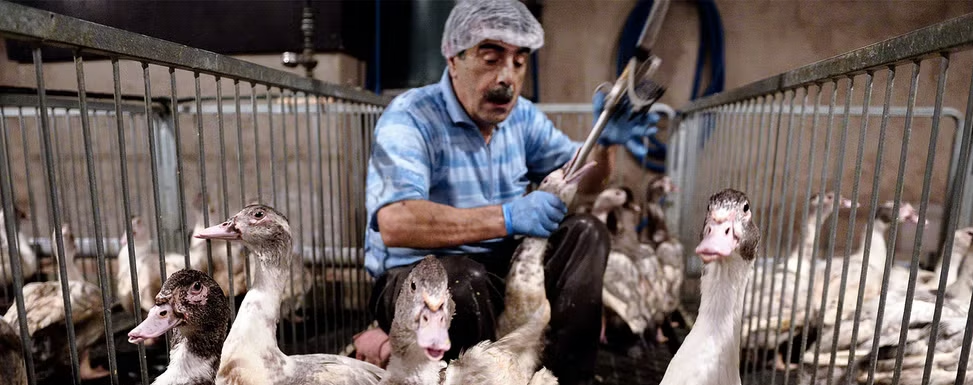
We know that foie gras production depends on force-feeding ducks until their livers swell to ten times their normal size. What we talk about less is what this process does to the people forced to carry it out, and to those who consume the end product. When we challenge this system, we’re fighting for everyone it harms.
From the inside, foie gras production is a harsh and dangerous job. From the outside, it’s a health hazard disguised as luxury. Behind every plate of foie gras are workers handling sick birds in dangerous, low-paid conditions. There are farmers exposed to waste and disease, and consumers served food that’s linked to contamination and neurological risk. The suffering extends beyond the ducks themselves to the people who do the work, the communities around the farms, and the customers who are kept in the dark about what they’re eating.
Working Conditions in the Foie Gras Industry
The people producing foie gras are among the most invisible in the food system. In France and Spain, most workers are temporary or migrant laborers hired during the busy winter season. They spend long days inserting metal feeding tubes into the throats of ducks, over and over, until the birds collapse from exhaustion.
Each worker may force-feed hundreds of ducks every shift. Repetition injuries are common. Wrists and shoulders give out, breathing problems develop from ammonia fumes, and protective masks are often missing. One foie gras worker told Equal Times, “Before, we took our time, but now it’s different, you have to work quickly. We work with living creatures, and there is a tendency to forget that.”
Inside a major U.S. foie gras factory farm, an investigator from Animal Equality describes crews moving through rows of ducks packed into small pens after force-feeding, many “covered in their own vomit.” That is the environment workers have to handle every day, lifting stressed birds, navigating slick, contaminated floors, and managing animals with visible throat injuries and broken beaks from the metal tubes.
On the slaughter line, staff are tasked with hanging birds by their legs while they are still conscious, then cutting their throats and moving the next crate into place. A manager on site said bleeding out took about 17 minutes. Whether or not that figure varies by setup, it points to the kind of grim routine workers are expected to maintain at speed, with gasping birds in crates around them and constant noise.
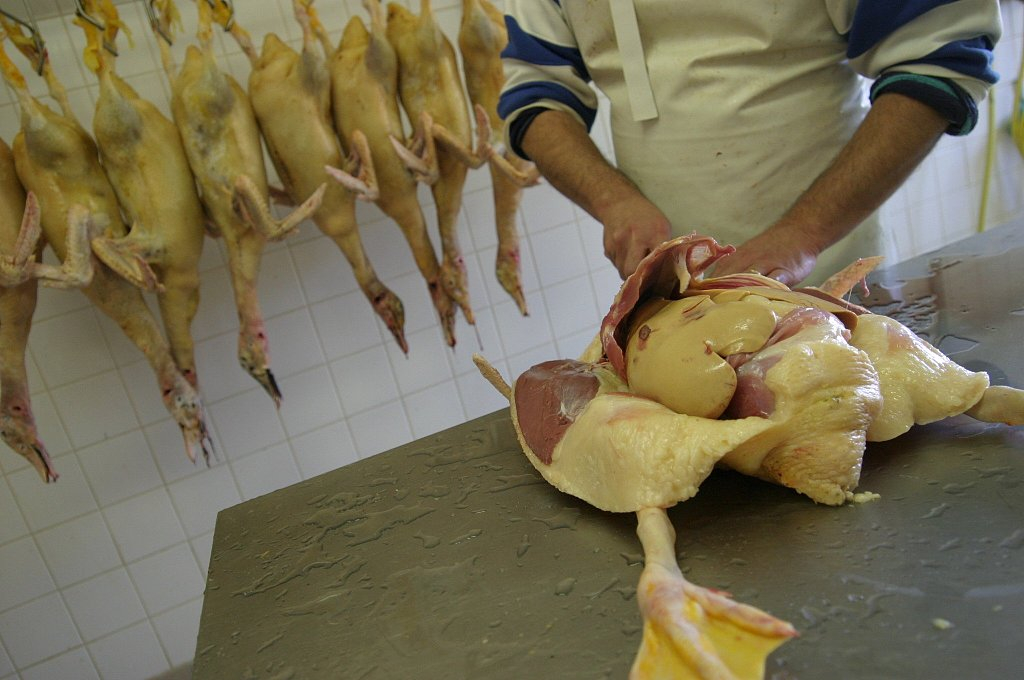
Let’s be clear about the “jobs” argument. In response to our 2026 ballot initiatives to end force-feeding of birds and the sale of force-fed foie gras, the industry will claim that preserving a handful of jobs force-feeding ducks is more important than ending systematic cruelty. That we should keep torturing animals because a few people make money from it. It’s the same argument that’s been used to defend every harmful industry throughout history.
Workers deserve better than jobs that require them to shove metal tubes down the throats of sick animals eight hours a day. The American and French economies have millions of jobs. We don’t need to preserve the cruel ones. What we need is the political will to say that some practices don’t belong in a modern society, regardless of who profits from them.
Building a kinder food system means creating an economy where no one has to cause unnecessary suffering to animals and themselves in order to pay the bills.
Why Political Action Matters
The good news? Communities don’t have to accept this system. When people are given the chance to weigh in on factory farming practices, they consistently choose compassion over cruelty. Nearly half of Americans support a ban on factory farming when asked directly, and an even higher percentage recognize it as an important social issue.
California became the first state to ban foie gras production and sales back in 2012, and recently, cities like Pittsburgh and Brookline, Massachusetts, have followed. Now, Pro-Animal Future is taking this further by empowering voters to say no to cruel force-feeding directly through ballot initiatives and citizen-led campaigns.
We’re showing that regular people (volunteers, small donors, and voters) can challenge even the most entrenched industries. But we won’t win unless we build coalitions across human rights movements. Factory farming has strong ties to worker exploitation, contamination risks, and environmental degradation. While not every person cares deeply about the plight of farmed animals, they recognize that a system causing this much harm to animals is inevitably harming humans too.
Emotional and Psychological Strain
Working in foie gras production affects more than physical health. Research on slaughterhouse workers shows higher rates of anxiety, depression, and intrusive thoughts compared with the general population. Reviews have found consistent links between this work and psychological distress, with clinicians describing PTSD-like symptoms in people assigned to kill or process animals.
Workers describe the first weeks as shocking, with vivid nightmares about the kill line, sweating awake, and a sense of shame about the job. As months pass, many report “going numb” to cope, separating their work self from their home self, and using alcohol or other substances to get through the stress. The same study links the pace and routine of killing to anger, short tempers, and conflict that spills over into family life.
Foie gras production puts workers in that category. People restrain ducks who are struggling. They insert feeding tubes and then move birds to slaughter. That mix of physical repetition, speed, and moral conflict is the ground where distress grows. The EU’s Scientific Committee on Animal Health and Animal Welfare has long noted the fear and distress caused to birds during force-feeding. The human side of that scene is a workforce asked to enforce it, which helps explain why similar mental-health effects show up in other animal-killing jobs.
A Closed-Door Industry
Foie gras companies intentionally avoid talking about their workers. Public labor data is nearly impossible to find, and most safety issues stay inside the plants. When things go wrong, it’s usually reporters or advocates who surface the story later, not the companies themselves. In southwest France, where much of the sector is based, reporting showed a shift toward bigger, faster, factory-style production. When bird flu or other crises hit, plants slowed or shut down, and many workers were put on partial unemployment. What that meant for people’s paychecks and health was never clearly explained to the public.
And when it’s challenged, the sector leans on “tradition” instead of offering public reporting about pace, exposure, and support for the people doing the work. If foie gras has nothing to hide, producers should publish injury rates, line speeds, and protective measures the same way they promote medals and holiday sales. Until there is basic transparency and independent audits, it is hard for diners to know what they are being asked to endorse.
health implications of eating foie gras
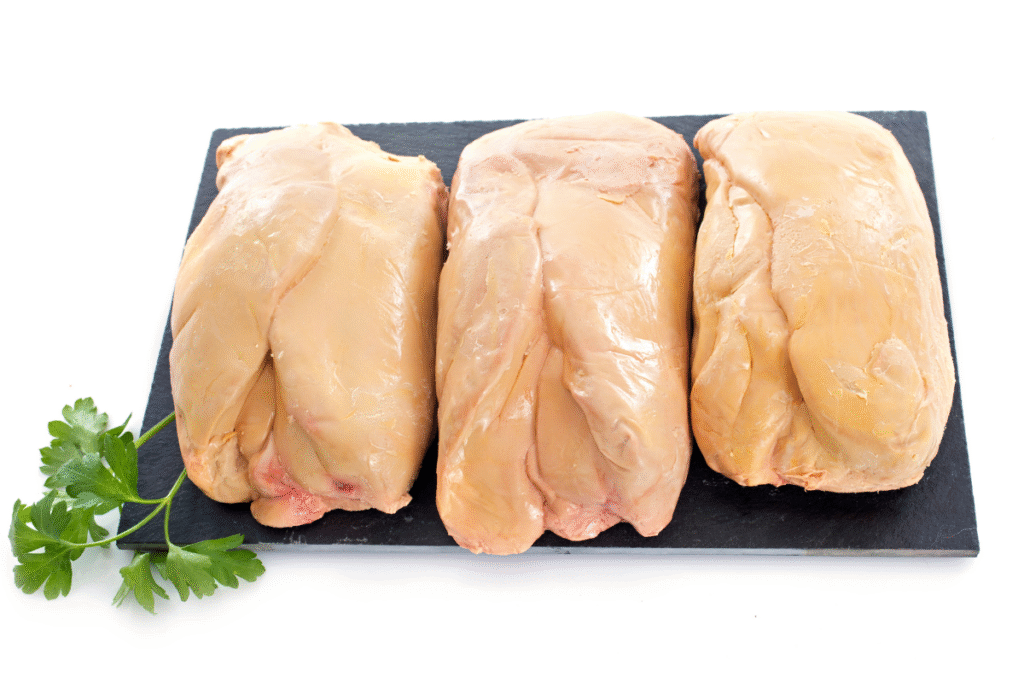
Regardless of how it’s presented, the reality is that foie gras is a diseased liver that’s been deliberately enlarged (i.e. fattened), and there are real questions about what that means for people who eat it.
Amyloid Proteins and Brain Health
One lab study tested store-bought foie gras and found protein fragments that tend to stick together and form “amyloid” build-ups. The researchers gave amyloid extracted from foie gras to mice that are already prone to a condition called AA amyloidosis, where these build-ups collect in organs like the liver and spleen. After exposure, the mice developed widespread deposits more quickly. The study does not prove harm in people, but it raises a food-safety question that has not been answered by large follow-ups.
Scientists discussing this work noted that amyloid in food may act a bit like a “seed,” speeding up disease in susceptible hosts, and suggested caution for people with chronic inflammatory conditions.
This is not a claim that a bite of foie gras causes Alzheimer’s or Parkinson’s, but it is a credible example of how it contains amyloid material that accelerates disease in a standard animal model. Until we have solid human data, it’s smart to play it safe.
Contamination and Foodborne Illness
Foie gras is often served mi-cuit or as a chilled pâté, which makes it a ready-to-eat product. If contamination slips in at any point in production, storage, or handling, there’s no final kill step at the table. Outbreaks of Listeria and Salmonella have repeatedly been traced to foie gras products in France, Spain, and North America. Listeria can survive refrigeration and is especially dangerous for pregnant people, older adults, and anyone with weakened immunity.
Duck livers themselves also pose a separate risk: Campylobacter is a common food-poisoning bacterium that can live inside liver tissue, so a quick sear on the outside is not enough. Undercooked duck or chicken liver pâtés have been tied to outbreaks for this reason. Shelf-stable foie gras also carries a small but recognized botulism risk if canning goes wrong. Botulism is rare, but the toxin can cause serious illness.
The Fat Factor
Foie gras is engineered to be fat-dense. During force-feeding, liver fat climbs from about 5% to over 60%! On the plate that shows up as over 400 calories per 100 grams, with 45 g of fat and around 15 g of saturated fat. For reference, the World Health Organization recommends keeping saturated fat below 10% of daily energy intake. So, for a standard 2,000-kcal day (and 22 grams or less of saturated fat), a small serving of foie gras (50 grams) will use a third of your limit in just a few bites.
A System Ready to Fall
Industry groups often claim foie gras keeps rural communities afloat, but that picture leaves out the reality for the people on the ground, doing the work. Foie gras production is seasonal and unstable, with every disease outbreak or dip in the market sending small farms into crisis mode. For the majority of workers, the job means long hours and little security, not to mention the emotional and psychological toll.
The outdated system is also really showing its age. Global production is declining because of avian flu, court rulings and public opinion. Cities like Bordeaux, Strasbourg, and Nantes have stopped serving foie gras at official events and public institutions, citing animal welfare concerns. In Paris, some chefs have dropped it altogether. One restaurant now offers a “faux gras” made from sunflower seeds and coconut oil. According to the chef, most diners are relieved to see it on the menu because they no longer eat foie gras at all.
Priorities are shifting, and more and more people are questioning whether an industry built on harm (to animals, workers and communities) still deserves a place at the table.
Building a better Food System
At Pro-Animal Future, we’re working to evolve away from factory farming by giving voters the power to decide what kind of food system we want. We’re running campaigns to end the sale of foie gras, a product that relies on one of the cruelest practices in industrial agriculture.
Here’s 3 ways you can take action today to help end the cruel force-feeding of birds:
- Sign Pro-Animal Future’s online petition to ask elected officials in major U.S. cities to end the sale of foie gras.
- Sign up to volunteer to help pass our anti-foie-gras campaigns (in person or remotely).
- Donate to fund organizing and advertising campaigns to ban foie gras in Washington DC, Denver, and Portland.
Pro-Animal Future is a grassroots political movement working to evolve beyond factory farming through local political action. [Learn more about us →]