

Independent research from Colorado State University finds that voters already strongly support banning foie gras from force‑fed ducks and geese, and that doing so is unlikely to hurt local restaurants.
Key findings at a glance
- 89% support a state‑level ban on force feeding ducks and geese to produce foie gras.
- 87% support bans on the sale of foie gras from farms that use force feeding.
- Including foie gras on a restaurant menu made people about 12 percentage points less likely to say they’d dine there.
What the CSU study looked at
Researchers at Colorado State University’s Animal‑Human Policy Center surveyed 5,665 residents across ten states, including Colorado, Oregon, and the District of Columbia. They examined public views on foie gras, support for bans on force feeding and sales, and how foie gras on a restaurant menu affects where people want to eat.
Public support for banning foie gras
The CSU research team found that the American public overwhelmingly supports ending both the sale and production of foie gras.
- 89% of Americans moderately or strongly support a state‑level ban on the practice of force feeding ducks and geese to produce foie gras.
- 87% of Americans support a city‑ or state‑level bans on the sale of foie gras coming from farms where force feeding is used.
- Around 81% of Americans support bans on the sale of all foie gras.
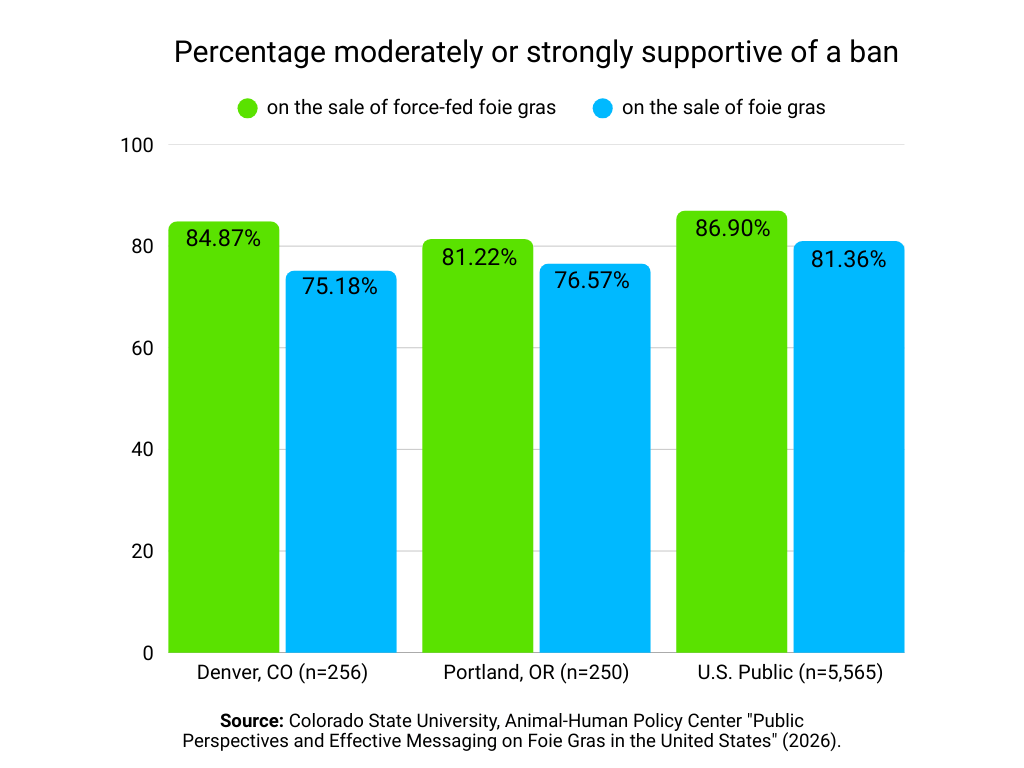
The chart shows that high support for banning foie gras from force‑fed ducks and geese is maintained when isolating the localities of Denver and Portland. In Denver, about 85% of respondents support a ban on the sale of force‑fed foie gras, compared with about 75% for a broader foie gras sales ban; in Portland, support is roughly 81% and 77%, respectively. Overall, across all 5,565 respondents, support rises to about 87% for banning the sale of force‑fed foie gras and 81% for banning foie gras sales in general. All of these figures are weighted to be representative of the general U.S. adult population based on 2024 Census data.
In practice, virtually all foie gras is produced by force‑feeding ducks or geese, so a ban on “force‑fed foie gras” is effectively a ban on foie gras as it is currently made. However, the difference between support for the two framings suggests that prohibitions would benefit from narrower language, as Pro-Animal Future’s proposed bans in Denver, Portland, and DC use.
New data suggests foie gras bans could have a positive economic impact
Opponents of foie gras bans often claim they will hurt local restaurants. CSU’s menu experiment suggests the opposite.
- People were randomly shown a real French restaurant menu either with two foie gras dishes or with those dishes removed (the menu was identical otherwise).
- 40.1% of those who saw the menu without foie gras said they’d be somewhat or extremely likely to dine there.
- Only 28.1% of those who saw the menu with foie gras said the same (a roughly 12‑percentage‑point drop, or a 30% relative reduction in likely customers).
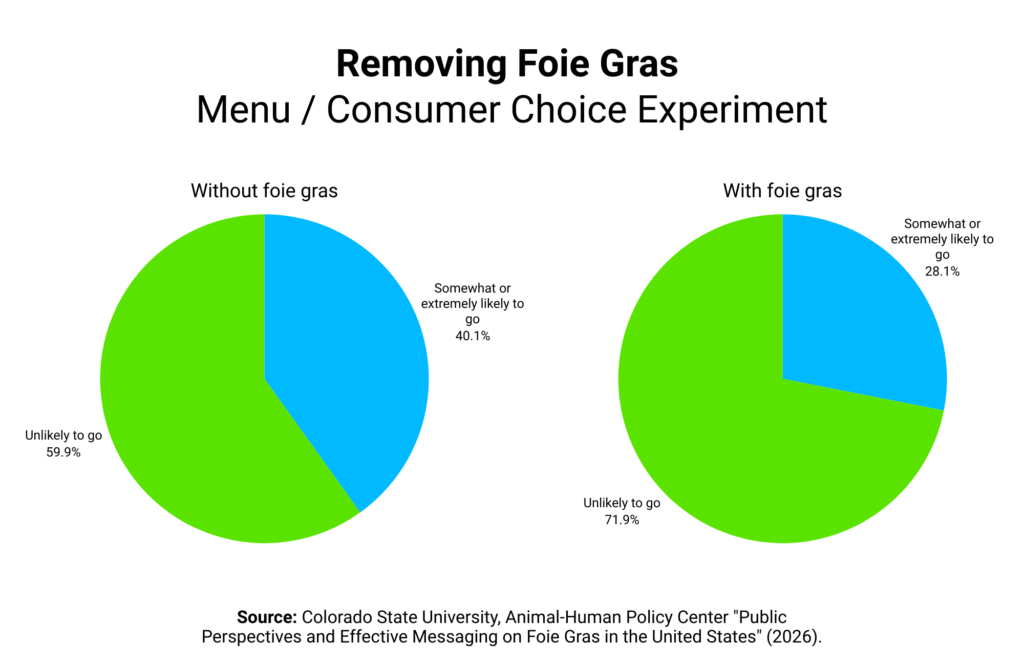
Very few respondents chose foie gras even when it was available, indicating that foie gras from force‑fed birds is not a key revenue driver for most restaurants, and certainly not a large driver for a city’s economy.
In fact, 61% of respondents in the study reported that they’d be more likely to visit a restaurant that removed foie gras from the menu for animal welfare reasons.
How force‑fed foie gras is produced
The CSU study also summarizes scientific evidence on how foie gras is traditionally produced in force‑feeding systems.
- Ducks or geese are repeatedly restrained and fed large quantities of corn‑based feed through a tube inserted into their esophagus, causing their livers to swell to 7–10 times their normal size, a condition known as hepatic steatosis.
- Scientific reviews have linked this process to pain and injury from tube insertion, stress during repeated handling, difficulty walking and breathing, liver disease, and much higher mortality rates than in standard rearing systems.
- Many birds are kept in housing that restricts movement and access to water, limiting natural behaviors like bathing and swimming.
These findings help explain why the majority of Americans support bans on the force-feeding of birds and the sale of foie gras. Read the full report published by Colorado State University here.