
Americans have been advocating to end foie gras for decades. Lobbying and relentless public pressure have steadily pushed foie gras off menus across the country. The wins are coming faster now, and keeping that pressure on is how we finish the job.
1990’s
1991: A PETA investigation at Hudson Valley Foie Gras in Upstate New York (then called Commonwealth Enterprises) brought the ethics of foie gras into American public consciousness for the first time. Undercover videos revealed birds struggling to breathe, unable to stand, and dying from ruptured organs. The footage shattered the industry’s narrative of “humane” production.
2000’s
2003: In Defense of Animals and Animal Protection and Rescue League, sued Sonoma Foie Gras for violating state animal cruelty laws. Public opinion strongly sided with the activists: a 2004 Zogby poll found that 77% of U.S. adults believed force-feeding ducks and geese for foie gras should be banned.
2004: The California state legislature passed the first foie gras ban in U.S. history (Senate Bill 1520) banning both force-feeding and the sale of products derived from it. It was set to take effect in 2012 after a long 7½-year phase-in period.
2005: The Illinois state senate’s Executive Committee took note and advanced a “Force Fed Birds Act” to outlaw force-feeding and foie gras sales (even though Illinois had no foie gras farms). Similar bills were introduced in Massachusetts, New York, and Oregon around that time. While none of those early legislative attempts outside California were successful, they built crucial momentum.
2006: Chicago became the first U.S. city to ban foie gras after a successful city council vote led by Chicago Alderman Joe Moore. Unfortunately, Chicago’s then-mayor openly mocked the foie gras ban as “the silliest law” council had ever passed. Chefs staged acts of defiance: a few Chicago restaurateurs began offering “underground” foie gras or giving it away free to thumb their noses at the law. Shortly after, the Illinois Restaurant Association (headed by a Chicago council member) mobilized to overturn the law.
2007: Wolfgang Puck (one of America’s most famous chefs) eliminated foie gras from all of his restaurants and catering operations after years of pressure campaigning by Farm Sanctuary and Humane World for Animals. By the late 2000s, Costco, Target, Safeway, and other grocery retailers had also stopped selling foie gras.
2008: The Illinois Restaurant Association (headed by a Chicago council member) mobilized to repeal the Chicago foie gras ban (sadly, of the 48 aldermen who had originally backed the ban, only 6 voted against repealing it). During that same year, Humane World for Animals (formerly HSUS), Farm Sanctuary, and others (unsuccessfully) petitioned the state’s New York Department of Agriculture to declare foie gras an “adulterated” (diseased) product unfit for sale, since force-feeding causes a pathological fatty liver.
2010’s
2012: As California’s foie gras ban was close to taking effect, over 100 high-end chefs signed an open petition protesting the California ban and even proposing “humane” foie gras standards as an alternative. Many restaurants held lavish “farewell to foie gras” dinners that spring, attempting to sell as much of the delicacy as possible before the law kicked in. Some chefs frankly admitted they planned to ignore the ban or find loopholes.
2013: Mercy For Animals released a shocking undercover video from inside Hudson Valley Foie Gras. The MFA investigation revealed fully conscious ducks being shackled upside-down for slaughter with throats cut, and dead ducks thrown into trash bins like garbage. MFA’s led a pressure campaign urging Amazon to stop selling foie gras (unsuccessfully, however, as foie gras can still be found on Amazon.)
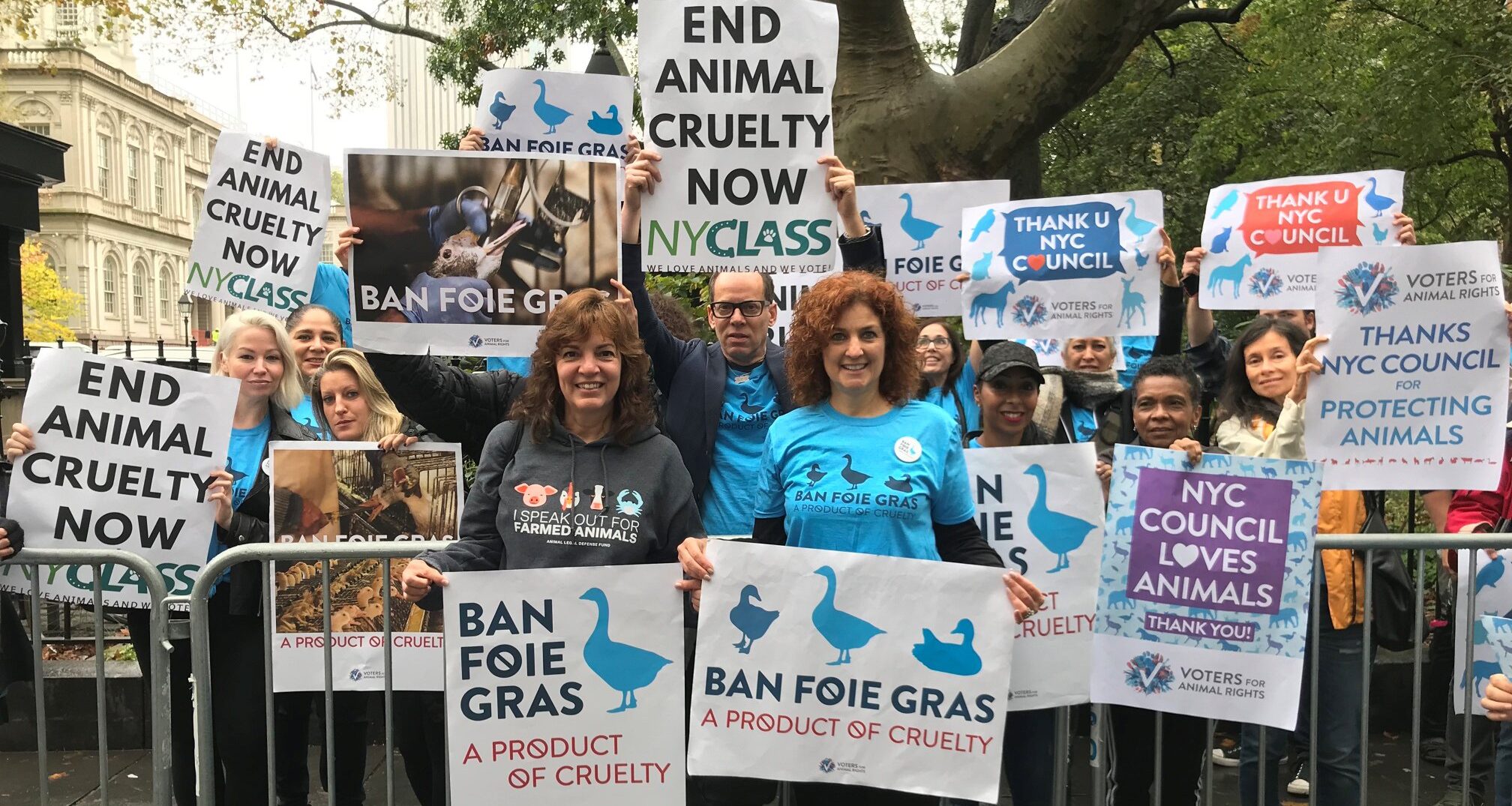
2019: Voters for Animal Rights built a coalition that included organizations like Farm Sanctuary, the ASPCA, and Humane World for Animals (formerly HSUS), and led a successful campaign to ban foie gras sales in New York City. After rallies, petition drives, and even support from some NYC council members who visited foie gras farms, the New York City Council voted overwhelmingly (42–6) to ban the sale of foie gras in restaurants and grocery stores in all five boroughs, with the ban set to take effect in 2022.
2022: Hudson Valley and La Belle sued, arguing that NYC’s law was unconstitutional and only the state can regulate poultry products. Meanwhile, industry lobbyists pushed the New York State Department of Agriculture to step in, and the agency claimed the ban violated state law. That move set the stage for the courts to officially reverse the NYC foie gras ban in 2024, ruling that New York City can’t overrule the state on agricultural issues.
2020’s
2023: The city of Pittsburgh banned foie gras thanks to the work of Humane Action Pennsylvania. Despite opposition from a few restaurant owners, the Pittsburgh City Council voted 7–2 to ban the sale and production of foie gras within city limits. Other cities in PA, including Philadelphia, are now considering similar measures.
2024: Hai hospitality (an award winning hotel and restaurant chain based in Texas) dropped foie gras after after a combination of protests, in-person disruptions, home demos, and a PETA petition that sent over 40,000 emails to the restaurant.
2025: Brookline, Massachusetts became the latest city to ban foie gras sales, initiated by two local high school students who gathered petition signatures and built a coalition. Despite some pushback from a few local businesses and the Chamber of Commerce, the ordinance passed with 114 votes in favor to 79 against. Less than a month ago, following over 200 protests staged in 28 US and Canadian cities organized by Duck Alliance and Animal Activism Collective, Omni Hotels (a company valued at over $3 billion) removed foie gras from all 50+ restaurants in its multi-state portfolio and finally committed to a foie-gras free policy.
Each of these victories proves that public compassion, once mobilized, is stronger than tradition.
5 Lessons We Can Learn About ENDING FOIE GRAS
Looking across these campaigns, a few practical lessons stand out for advocates working to end foie gras production and sales.
1. Keep passing strong local laws
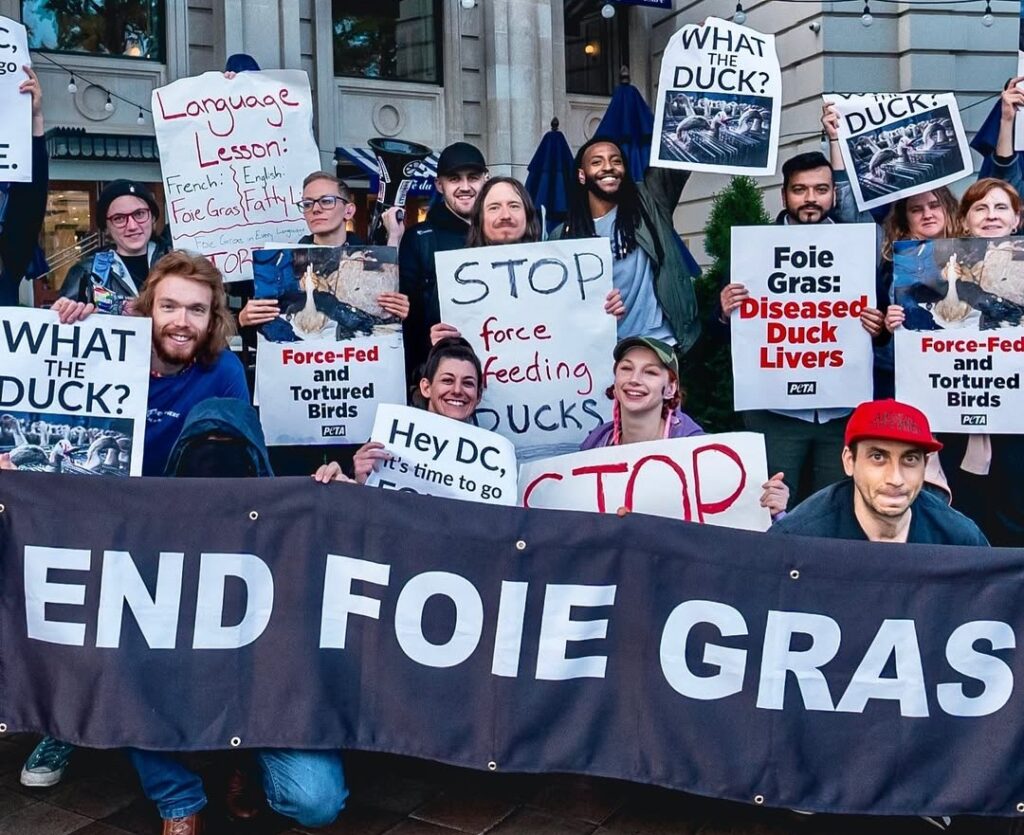
California’s model proved that well-crafted legislation can withstand years of lawsuits. The next wave will come city by city. Pro-Animal Future’s chapters in Denver, Portland, and Washington, D.C., are working to pass citywide ordinances to prohibit the sale of force-fed foie gras. We hope that these initiatives will set the stage for broader national reform.
2. Focus on Achilles’ heelS
Only a small number of producers and prestige buyers sustain foie gras’s public image. By focusing campaigns on high-visibility restaurants and retailers, advocates can dismantle the illusion of luxury. Over the past two years, more than 100 U.S. venues have removed foie gras entirely, thanks to targeted campaigns and persistent outreach. Due to the recent wins, pressure campaigns targeting businesses that sell foie gras will likely become more widespread.
3. Keep telling the truth, again and again
While many Americans already know about how foie gras is made, there are still many who don’t. That’s why a core element of Pro-Animal Future’s ballot initiative campaigns is outreach and education. Every conversation at a farmers market, every petition signature, every commercial, every poster, and every city council testimony moves us closer to a world where foie gras disappears for good.
4. Build momentum towards bigger wins
Foie gras is a weak link in factory farming. It has low public support, it is a clear example of unnecessary suffering, and opposing it crosses ideological lines. Banning foie gras opens the door to deeper discussions about how farmed animals are treated and the urgency of ending factory farming.
5. CITIZEN ENFORCEMENT MATTERS
In 2025, an Animal Outlook investigation found that Wild Fork Foods, a subsidiary of JBS, was selling foie gras in multiple Southern California locations in apparent violation of state law. The company didn’t remove foie gras from its California stores until the issue was documented publicly and investigated, and later, they stopped selling it across the U.S. and Canada. The case is a reminder that legislation alone is not enough. Ongoing monitoring, public reporting, and citizen involvement remain essential to ensure that bans are followed in practice.
Here’s 3 ways you can take action today to help continue the fight to end foie gras, for good:
- Sign Pro-Animal Future’s online petition to ask elected officials in 3 major U.S. cities to end the sale of foie gras.
- Sign up to volunteer to help pass our anti-foie-gras campaigns (in person, or remotely).
- Donate to fund advertising campaigns to pass our concurrent ballot initiatives to ban foie gras in Washington D.C. and Denver.
Pro-Animal Future is a grassroots political movement working to evolve beyond factory farming through local political action. [Learn more about us →]