

A public-opinion poll commissioned by DC Voters for Animals finds overwhelming, cross-ward support for banning foie gras made by force-feeding birds.
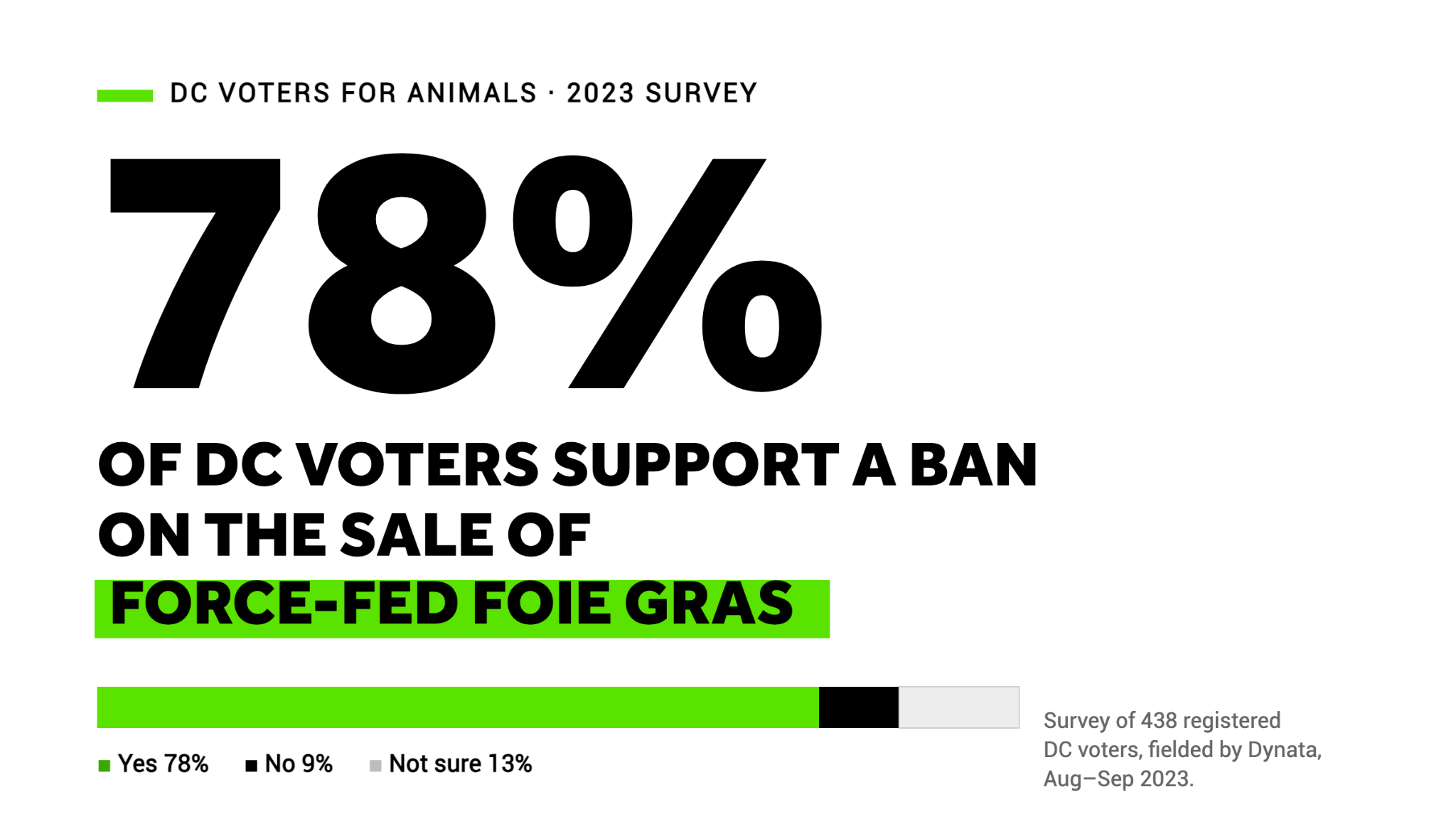
When it comes to how animals are treated, DC voters are far more united than our politics might suggest. A public-opinion survey commissioned by a local organization called DC Voters for Animals finds that residents overwhelmingly want the District to end the sale of foie gras produced by force-feeding ducks and geese.
78% of DC voters would support a citywide law to end the sale of force-fed foie gras. Fewer than 9% were opposed, and the rest were unsure. That support was consistent across wards, age groups, and diets.
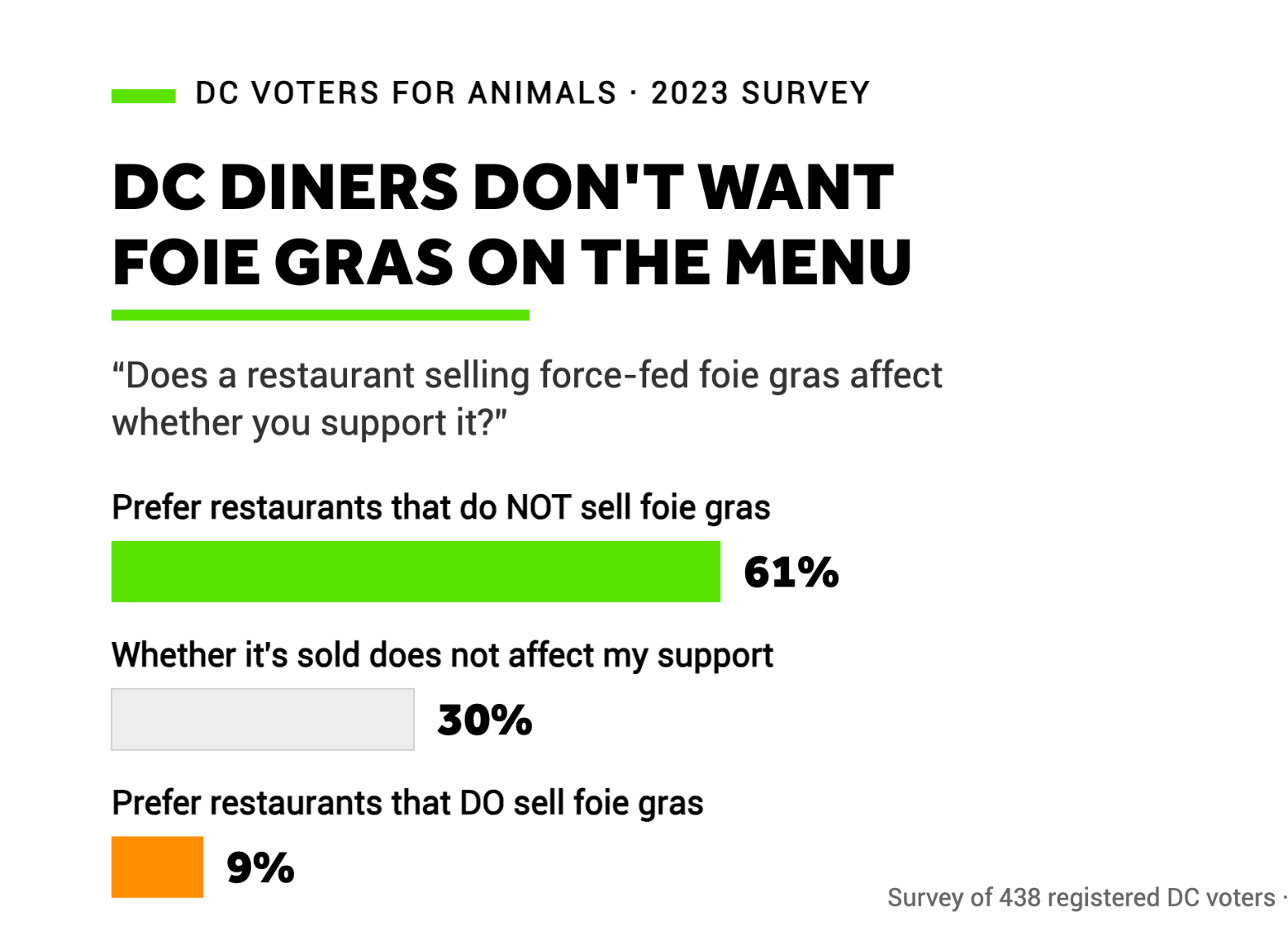
A majority of DC diners don’t want to see foie gras on the menu. Force-feeding carries such a negative association that most residents would rather take their business elsewhere. 61% said they prefer to support restaurants that do not sell foie gras, compared with just 9% of DC voters who prefer restaurants that do.
Few DC residents actually eat foie gras. More than half of DC voters say they never eat foie gras, and only about 8% eat it as often as once a month. In addition, approximately half of voters (46%) know that most foie gras production involves force-feeding birds.
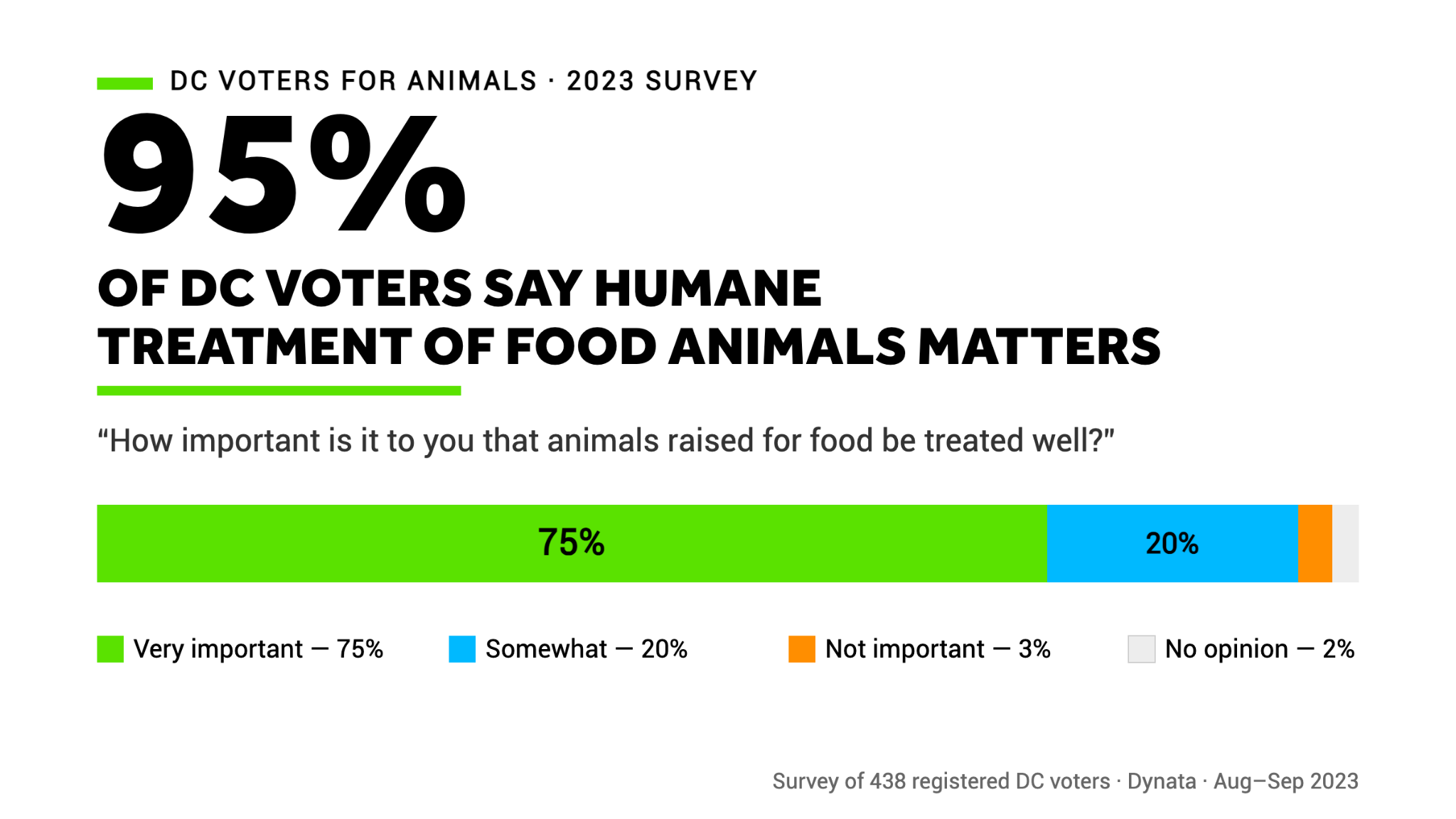
95% of DC voters said it matters that animals raised for food are treated well. This includes 75% who said it is “very important.” Only about 3% said humane treatment of animals was not important to them.
methodology
This section is for readers who want to see the methodology and data behind the figures presented above.
How the survey was conducted
- Commissioned by: DC Voters for Animals
- Polling firm: Dynata
- Sample: 438 registered District of Columbia voters
- Field dates: August 29 – September 29, 2023
- Geography: All eight DC wards represented
- Statistical testing: 95% / 90% confidence (z-test); percentages based on total answering
Sample composition (n=438)
| Characteristic | Breakdown |
| Age | 18–29: 23% · 30–44: 31% · 45–54: 25% · 55–64: 9% · 65+: 12% (mean age 43) |
| Gender | Man: 55% · Woman: 44% · Non-binary: 1% |
| Race | White: 54% · Black/African American: 34% · Hispanic/Latino: 5% · Asian/SA/PI: 2% · Other/multiple: ~4% |
| Education | Bachelor’s degree: 31% · Postgraduate: 28% · Some college / associate: 28% · HS or less: 13% |
| Household income | <$40k: 14% · $40–75k: 17% · $75–100k: 18% · $100–150k: 20% · $150k+: 27% |
| Diet | Omnivore: 61% · Flexitarian: 21% · Pescetarian: 8% · Vegetarian: 7% · Vegan/plant-based: 3% |
| Wards | Roughly even across Wards 1–8 (9–15% each) |
Full question results (n=438)
How important is it to you that animals raised for food be treated well?
| Response | % |
| Very important | 75.3% |
| Somewhat important | 19.9% |
| Not important | 2.7% |
| Don’t know / no opinion | 2.1% |
| Important (net) | 95.2% |
Would you support a citywide law in DC to prohibit the sale of foie gras made by force-feeding birds?
| Response | % |
| Yes | 78.3% |
| No | 8.7% |
| I don’t know | 13.0% |
Support was distributed evenly across all eight wards. It also held across diet groups: majorities of omnivores, flexitarians, vegetarians, and vegans alike backed a ban.
Does whether a restaurant sells foie gras from force-fed birds affect whether you’re likely to support that restaurant?
| Response | % |
| Prefer restaurants that do NOT sell foie gras | 60.7% |
| Whether or not it’s sold does not affect my support | 30.1% |
| Prefer restaurants that DO sell foie gras | 9.1% |
Prior to this survey, did you know that foie gras production involves force-feeding?
| Response | % |
| Yes | 46.3% |
| No | 39.3% |
| Had not heard of foie gras before | 14.4% |
How often do you eat foie gras?
| Response | % |
| Never | 51.8% |
| Unsure / don’t know what it is | 5.9% |
| Less than once per year | 13.7% |
| 1–2 times per year | 11.2% |
| 3–11 times per year | 9.8% |
| At least once per month | 7.5% |
Notable demographic patterns
- Awareness tracks consumption. Voters who eat foie gras more frequently were far more likely to already know it involves force-feeding; the majority who “never” eat it were also least aware of how it is produced.
- Frequent foie gras eaters skew male and higher-income. Among the small share eating it monthly, 85% were men, versus 55% of the sample overall.
- Concern for animal welfare is broad-based. “Very important” responses to Q3 ranged from 63% (Ward 8) to 86% (Ward 7), with no ward falling below a clear majority.
Source: “Attitudes on Foie Gras,” a survey of registered DC voters commissioned by DC Voters for Animals and fielded by Dynata, August–September 2023. Reported figures use the final n=438 dataset (fielded through 9/29/23); an earlier n=500 cut (through 9/11/23) showed 73% support for a ban.